
TGOA: The Analyst Guide to Agentic PIM
The Future Will Be Autonomous.
How is Agentic PIM transforming product data management? TGOA’s Analyst Guide examines the potential and challenges of this development and highlights ATAMYA’s approach.
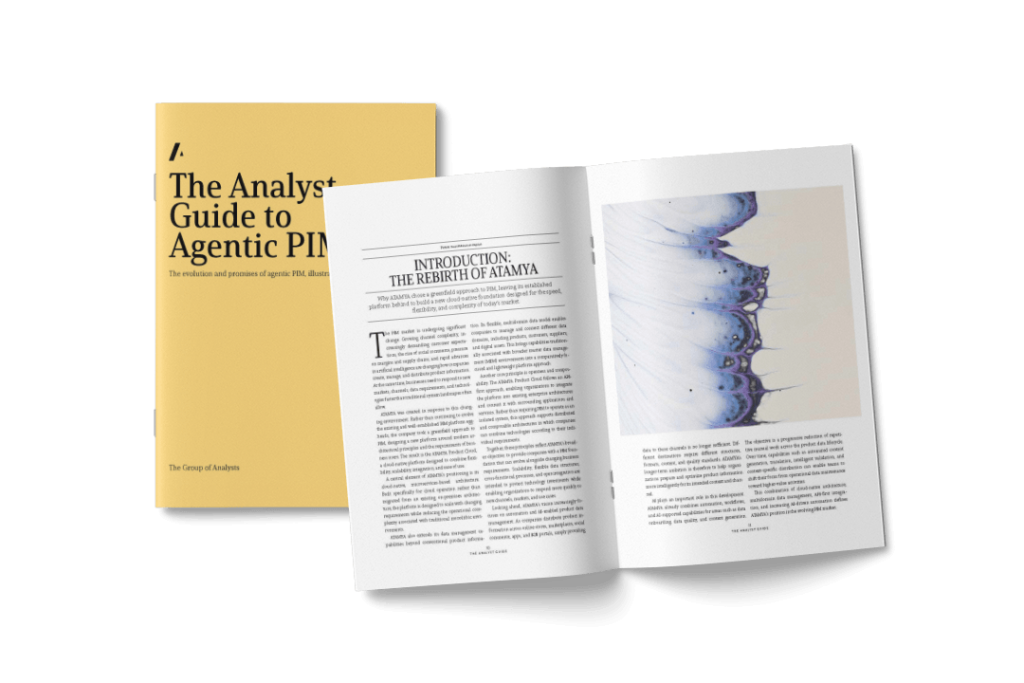
Product data processes are becoming more complex, and the demands for efficiency and speed are increasing. Agentic PIM opens up new possibilities for overcoming these challenges: with AI agents that can not only support individual tasks but also coordinate entire workflows.
The Analyst Guide was compiled by The Group of Analysts (TGOA) in collaboration with ATAMYA and provides context for this development. It highlights where the potential lies, what prerequisites companies must establish, and how the economic benefits can be assessed.
In this guide, you’ll learn:
An English-language analysis by TGOA, illustrated using ATAMYA as an example.
“The nature of typical PIM processes makes the entire product content lifecycle an ideal area for automation and AI. Multiple steps, tasks, and responsibilities, lots of manual efforts, and the central role of product data for driving sales, customer experience, and brand awareness indicate that automation can potentially generate numerous business benefits.”
–Carmela Melone, co-founder and senior analyst TGOA
Using ATAMYA as an example, the Analyst Guide demonstrates how a modern PIM architecture enables the intelligent automation of product data processes.
Fewer manual steps. Faster processes. But what specific benefits does Agentic PIM offer your company? The Analyst Guide from The Group of Analysts (TGOA) analyzes the opportunities, challenges, and business value using ATAMYA as an example.
You can acesss a free preview without having to register.

A powerful LLM alone does not automate the product data process. What matters most is the interplay between data, workflows, and clear rules. Using ATAMYA as an example, the TGOA Analyst Guide shows exactly why that’s where business value is created. You can get a free preview without having to register.

ATAMYA PIM
Resources


