Whitepaper
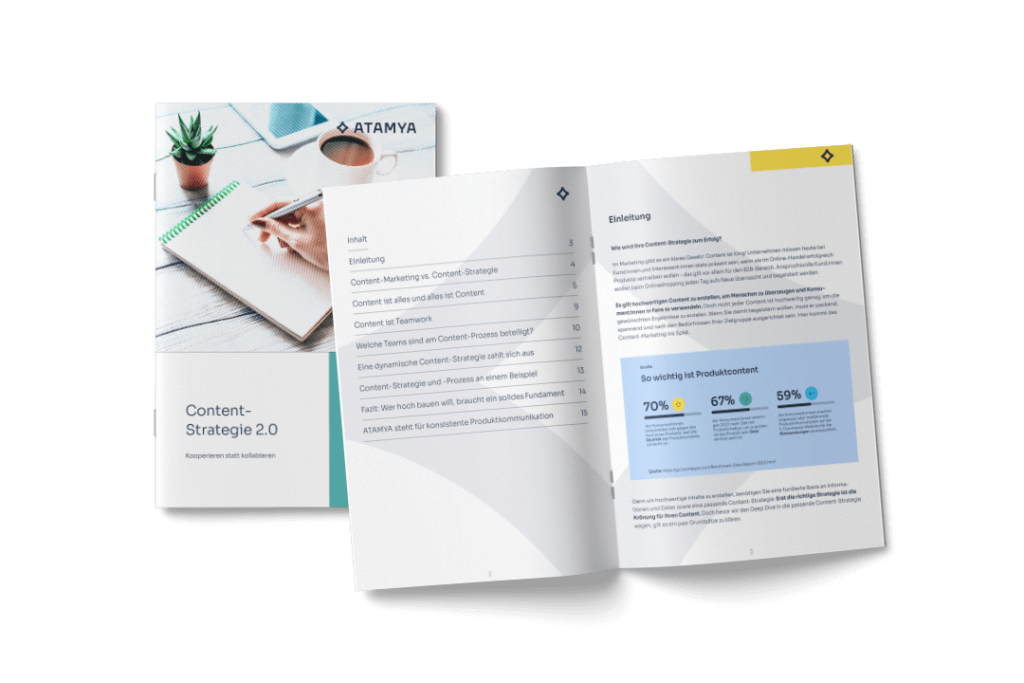
Good Content Deserves a Strong Strategy
This whitepaper demonstrates how you can connect both optimally. Launch your content strategy 2.0 today.


Luisa Reichenbacher
17 / 12 / 25·6 Min read
Data Management
Digital media assets have direct influence on the quality of customer communication, yet small or medium-sized enterprises only rarely give them the priority they deserve. The problems caused by this negligence often times only become noticeable once search times multiply or multiple file versions are already circulating. Shorter product iterations and new touchpoints require more and more variants of media assets that asset management needs to keep up with.
Accordingly, many SMEs find themselves confronted with the question of how to efficiently organize the ever-growing pile of assets. This is because unnecessary search time, redundant data storage and errors caused by outdated files are sure to occur given the lack of clear structure. Digital Asset Management (DAM), however, offers a way to bring order into your media environment and visibly reduces the workload for teams.
In small and medium-sized enterprises, digital assets are often times stored in a decentralized manner and not maintained systematically. Files accumulate on server drives, in private folders, e-mails, Cloud services, or external tools, making it easier and easier to lose oversight. Working in small teams and growing product variety, in particular, leads to unstructured storage methods with long search times, wrong versions, and tedious coordination between marketing, sales, and product management.
Online shops find themselves confronted with even more challenges. Product images, graphics, or videos must be provided in both different resolutions and formats for diverse channels. Platforms for marketplaces, ecommerce portals, or social media have different requirements concerning size and quality of media assets. If an asset is updated, it remains unclear whether all channels and partners are always using the most recent version. Without a central storage system and clear processes, it is nigh impossible for small teams to solve task efficiently.
Especially for SME online shops, it is decisive that digital assets are well-structured, easy to find, and maintained consistently. And it is here that Digital Asset Management (DAM) comes into play: it operates in the background, brings order into the asset chaos, and keeps everything well-maintained, without any additional effort by your team. Equipped with this, even small teams gain control over their full media environment, can provide new products faster, and secure the quality of their customer communication.
Common Problems with Digital Assets
These challenges are particularly frequent in small and medium-sized enterprises. The teams are smaller, roles are less specialized, and there is no time to spare for organized asset management. At the same time, the demands keep growing for consistent brand and product communication. As soon as even a single wrong or outdated file is published, it will quickly spiral into miscommunication with customers and retailers.
At its core, a DAM system serves as the central platform for all digital media. It creates order, makes content easy to find, and guarantees efficient workflows. Here, the focus is not on the software but the use it grants to people that work with media on a daily basis.
A SME manufacturer with around 4,000 product variants would be the paradigm example for many companies facing themselves in this very situation: a small marketing team of three people edits requests from sales, product management, and branch offices on a daily basis. On top of all that, there are retailers that regularly require images in all sorts of formats. The media is stored on server in a folder structure that grew over the years and that hardly anyone has a full grasp of anymore.
The consequences are typical: employees will need some time until they search and find the right image. Different teams use different versions of files. External service providers must occasionally wait for material. At the same time, new media is created that must be stored somewhere but which cannot be clearly assigned yet.
After the introduction of a DAM system, the company has implemented a well-structured media library. Categories, meta-data, and collections establish order. The system clearly displays the current version of the relevant file. Retailers and external partners gain independent, controlled access to approved content. The marketing department receives significantly less further inquiries and can, consequently, shift focus to campaigns, content creation, and brand management.
This example shows that a central DAM system such as TESSA DAM makes it easier for teams to structure media in a clear manner and makes processes drastically more efficient without adding extra complexity for its users.
Additionally, many SMEs also utilize a Product Information Management (PIM) system, such as ATAMYA, to handle product data in a structured manner. A DAM complements this process in a meaningfully way by providing images, videos, and documents in real time. Clear relations between product and media data can be established and maintained. This assures consistent exports to online shops, catalogs, ecommerce platforms, or for marketing materials. There are no rigid borders to be drawn here since the interplay of both systems supports companies visibly in their professional product communication.
Digital Asset Management for SMEs is far more than just another technical solution. It is a strategic cornerstone for handling digital media intuitively, sky-rocketing efficiency, and alleviating pressure from teams in day-to-day business. Those who have many products, variants, or communication channels, in particular, profit from central asset management.
A DAM system helps creating order, preventing errors, and fostering collaboration. This allows companies to react faster to market requirements and provide consistent, high-quality content to their customers.
Author:
Luisa Reichenbacher
Marketing Manager at EIKONA Media GmbH
Whitepaper
Good Content Deserves a Strong Strategy
This whitepaper demonstrates how you can connect both optimally. Launch your content strategy 2.0 today.
These articles may also interest you