Whitepaper
Digitize Your Product Data
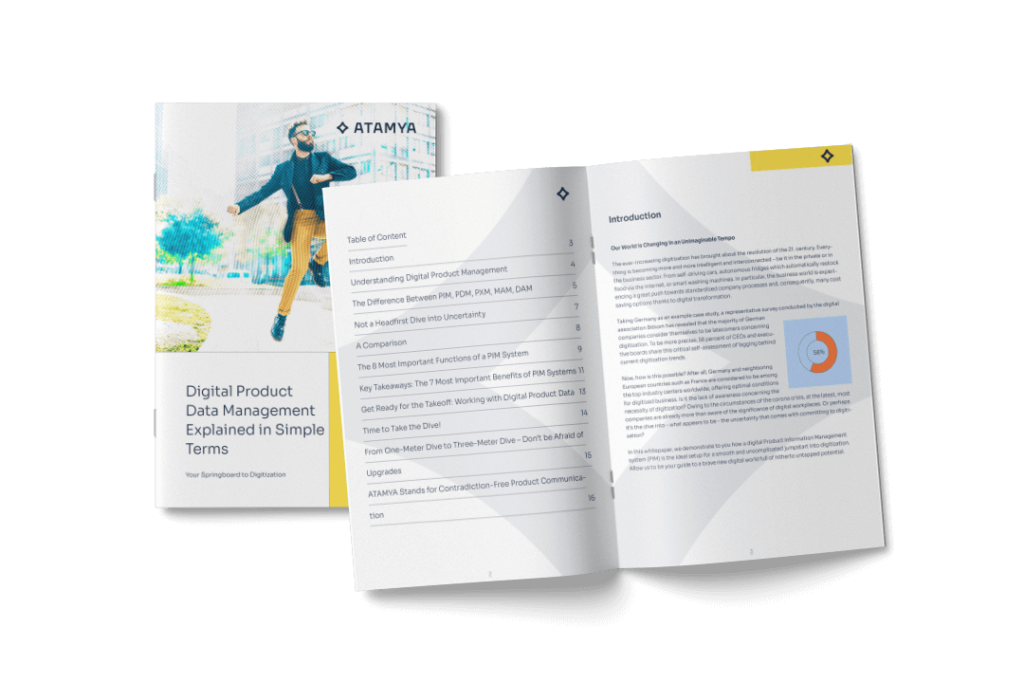
In our whitepaper, we let you in on how you can quickly make the shift from manual processes to smart workflows with a PIM system – intuitive, concrete, and easy to implement.


Marko Stuka
09 / 03 / 26·9 Min read
Data Management
It usually begins harmlessly enough: A new product is about to enter the go-live phase. Marketing is waiting for content. E-commerce requires images and attributes. Sales asks for specifications. IT is checking interfaces. And somewhere in the heart of all this lies a single Excel file containing the current state of affairs – most likely update number 17 thereof. What surfaces here is not an operative problem. It is a structural one. Product data has long since advanced from its shadowy existence as a backend topic. It now constitutes the very backbone of the digital value chain.
The actual problem is rarely the quantity of data but accessibility. In many companies, product information is organized as data islands: Only a handful of specialists maintain it, while all other teams must rely on approvals, inquiries, or manual transfer.
Those who wish to scale, internationalize, and operate omnichannel in serious fashion require more than a PIM system. What it takes is an organization where product information does not remain isolated in individualized departments but is made accessible to all relevant roles in an organized manner. It is precisely here where the data democratization in Product Information Management begins. And this is not merely a comfort function but a strategic response to exponentially growing complexity.
This concept defines a paradigm shift in handling product data: The days of expert systems designed for the chosen few are numbered; now the trend gravitates towards a platform where many teams collaborated in a structured manner. Product data is hereby mobilized as a shared resource rather than being relegated to specialists only.
Each and every relevant role in the company can use and edit product information within the boundaries of a well-defined rule set. The underlying principle is called Governed Autonomy: say yes to self-service – but with roles, rights, workflows, and quality rules. The more people work on and with product data, the more important structured processes. Democratization without governance creates but chaos. Governance without accessibility creates but deadlocks. It is exactly here where a modern PIM can be of utmost strategic relevance.
The market is moving faster than many data models and, at the same time, expanding into all sorts of directions at once. And the more complex the markets, the more important access to product information is.
E-commerce, market places, social commerce, B2B portals: Product information must be distributed in a way that is context-sensitive, well-adjusted in its tone, and optimized for the individual channel. Marketing expects central product information and flexible multichannel support. Every additional channel multiplies the requirements concerning structure and consistency. When product data is only managed by a few specialists, however, every new channel automatically turns into a chokepoint. Data democratization solves exactly this problem: it shares responsibilities for product information with the teams that actually use it on a daily basis.
Unstructured data masses, manual processes, and missing governance slow down efficiency. Product data must be analyzable, structured, and consistent – not merely available. Accessibility without reliability does not constitute a competitive advantage.
Management expects process simplifications, efficiency optimization, and a positive cost-use effect from digital systems. To this end, product data is not a side show. It is the very infrastructure of scalable growth. If each product information record must be processed by a selected few experts, you naturally run into a scalability problem. Data democratization is the solution to this bottleneck.
Classic Product Information Management used to be a dedicated specialist’s tool. Today’s requirements, however, are not about a tool only a few know how to operate but a platform that everybody in the company is happy to use. Exactly this transformation is described by data democratization in PIM: Product data advances from an operative specialist topic to a collaborative workbench for product management, marketing, commerce, and IT.
Today, a PIM system stands for:
This is not a technological luxury. It forms the very foundation so that product data does not collapse into a bottleneck.
Modern principles of architecture like MACH (Microservices, API-first, Cloud-native, Headless) promote modular and adaptive systems. (Source: MACH Alliance, MACH Explained). These architectonic principles are more than just technical details. They are the technological foundation allowing data democracy to function in the first place. Only when systems are open, flexible, and integrable, can multiple teams work with them at the same time to structure product information.
For companies this means: Product information is no longer self-contained as a monolithic system but is now flexibly integrated into commerce platforms, publishing tools, and further systems.
ATAMYA was developed from scratch as a cloud-native platform on the basis of MACH principles. The modular architecture is based on microservices enabling technical scaling and high maintainability.
How is all this relevant for growth? Because systems can easily transform into barriers that obstruct scaling.
When product data is structured centrally while also being usable in a decentralized manner, the following effects can be measured empirically:
The product data widens from a bottleneck into a growth platform. ATAMYA consciously follows a minimalistic and clear usability-centered method to reduce complexity and empower business users. This is because democratization only functions well when the system feels intuitive and is willingly used by everybody.
Many companies try to generate growth across new channels, markets, or product assortments without fundamentally adjusting their very data foundation. This works – as a short-term solution. In the long term, operative complexity emerges that grows continuously.
To provide an example for this: The so-called Digital Product Pass demands product-related information about source, materials, and supply chain. The question ‘Where was my t-shirt produced?’ cannot be a question concerning a single employee. Knowledge must never be limited to just one person. Whenever such an individual falls ill or leaves the company, the search is quick to enflame. Who else could know about this? In which Excel table could we find this specific piece of information? And with every manual knowledge transfer, the risk of inconsistency increases.
Data democratization prevents exactly these dependencies. Product know-how should not be an insider privilege after all. What it takes is a so-called single source of truth, i.e. a central place where product information is structured, traceable, and accessible by all relevant roles.
And this is not only exclusive to the ‘hard facts’ of your master data. Selling something nowadays means more than selling measures, materials, and article numbers. What you sell is a story.
When this story unfolds consistently, trust comes to be. If it is self-contradictory, doubt arises. Consistency sells!
Data democratization in PIM means, therefore, not only better data management. It means nurturing the ability to tell a consistent, trust-worthy product narrative across all touchpoints – with clear rules, processes, and clear responsibilities.
No longer:
‘Who is currently in charge of that kind of information?’
But:
‘Where is this data stored structurally and who can utilize it in which context?’
While AI is all the rage in the markets these days, the actual motor for scaling lies dormant somewhere else entirely: in structured data models, well-defined roles-and-permissions concepts, as well as in automatic workflows. Only once this foundation is secured can you enjoy authentic acceleration. And this speed is the requirement for sustainable growth.
Product Information Management today is no longer an administrative task. It is a strategic potential that decides how fast, consistent, and reliable a company can act in the market.
Data democratization in PIM holds the following significance:
Data democratization does not unfold its effect within a single department. It influences architecture, processes, and results all at the same time. It does the heavy lifting for IT, accelerates commerce, and makes growth plannable.
ATAMYA Product Cloud has been developed for precisely this demand: cloud-native, API-first, and modular design are all conceived through the user’s perspective. The introduction is deliberately kept simple: companies can get themselves started faster and expand their product data processes step by step, while the requirements can grow along the way.
This is how PIM turns into a platform that grows together with your company. So that product data is not only administrated but utilized strategically. Growth needs more than adding new channels. Growth requires structure. And structure begins with your product data. At the end of the day, what matters is this: Those who do not democratize product data scale complexity rather than sales.
Author:
Marko Stuka
Senior Sales Manager
ATAMYA
Whitepaper
Digitize Your Product Data
In our whitepaper, we let you in on how you can quickly make the shift from manual processes to smart workflows with a PIM system – intuitive, concrete, and easy to implement.
These articles may also interest you

ATAMYA PIM
Resources