Whitepaper
Digitize Your Product Data
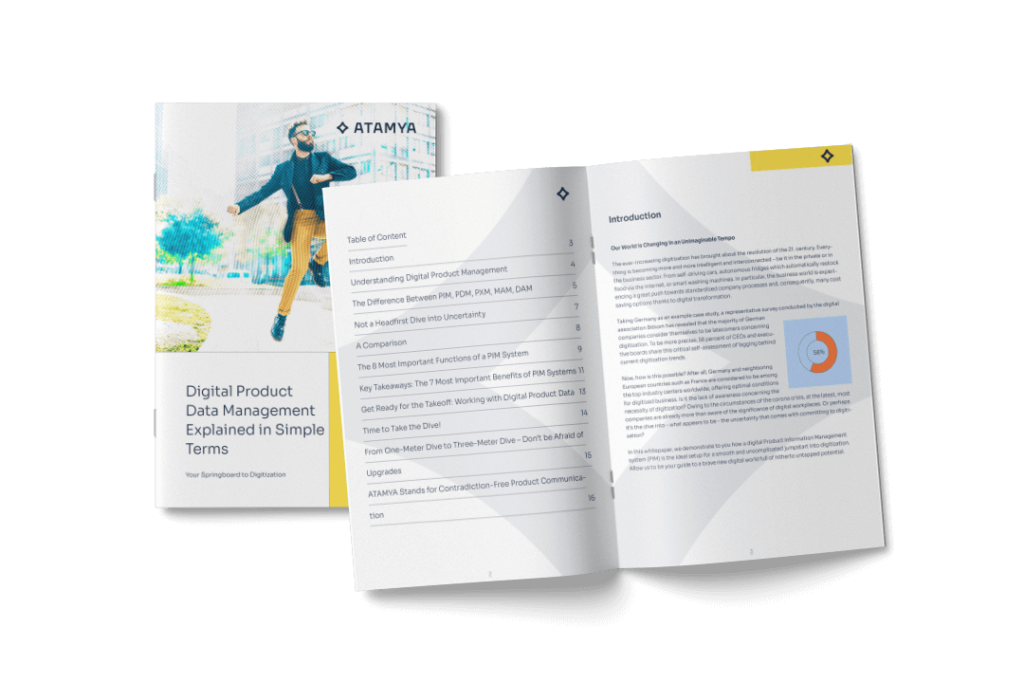
In our whitepaper, we let you in on how you can quickly make the shift from manual processes to smart workflows with a PIM system – intuitive, concrete, and easy to implement.


Yana Zabolotna
05 / 12 / 25·6 Min read
Digital Experience
Digital commerce finds itself before a thrilling phase. Whereas some may speak of a disruption, what is currently transpiring does in fact feel more like an upgrade to the next-higher e-commerce version: more intelligent, more visual, more modular, and faster than ever.
In B2B, in particular, a noticeable dynamic is emerging: Complex products as well as an increase in both requirements and digital sales paths, like B2B marketplaces, make it so that modern commerce trends can have an extraordinarily significant impact here. One minor spoiler: There is simply no way around AI anymore.
Here are the five trends that will call the tune in 2026, and all of them have one thing in common: Without clean product data, they are not going to work.
Trend analyses like Quid Report (The State of AI in E-Commerce: 2025 Quid Trend Report) indicate: Immersive technologies such as 3D models, virtual product views, and augmented reality are gaining more and more ground in e-commerce. Increasingly more retailers and manufacturers work on making digital products livelier and more inspiring, in order to make the purchase decision easier for customers.
While it is often times AR/VR that makes for the inspiration in B2C, they take on a much different significance in B2B: They help you present complex products in an exact manner. Before they even place their order, construction teams and purchasers want to examine if a component will fit, what measurements are of relevance, or how a specific module will run in the existing infrastructure.
A typical example: A complex product is provided as a rotatable 3D model. This allows you to evaluate measurements, ranges of motion, or junction points first-hand in your browser. And it is precisely this that makes immersive commerce approaches so valuable: They reduce further inquiries, accelerate decisions, and bring transparency into the technical product landscape.
If you want to dive deeper into the topic of product experience and learn how product experience can be optimized in a targeted way for B2B, we recommend to you our expert interview: Product Experience in B2B: Why the Turning Point is Now.
AI is increasingly being used to design product variants before they go into physical production. This enables companies to define faster which variations are truly relevant and which are not. Instead of creating every single variant manually or validating it only after production, digital concepts are designed first in order to test them internally or in small sample groups.
A typical example: A technical component is generated in multiple digital variants, including different measures, materials, and geometries. Constitution, development, and sales can evaluate even at early stages which version is meaningful and which variant requires further adjustments. The benefits are obvious: Less maldevelopment, faster feedback loops, and decisions firmly grounded upon real requirements.
In e-commerce, everything that renders processes faster, more precise, and less error-prone is gaining significance. And it is exactly here where AI unfolds its intrinsic strengths. More and more companies trust in automated recommendations, intelligent price logics, and predictions for availability and demand.
This is of particular value especially in B2B: Wearing parts, components, or consumption materials can be ordered on the basis of past data or appropriate software predictively. A practical example: A system identifies that a specific component ought to be replaced after a certain usage period – and automatically recommends the order at just the right time.
This reduces non-payment risks, alleviates a burden from teams, and makes commerce less reactive and more predictive.
Circular commerce becomes more prominent as a supplement to classic order processes. In B2B, in particular, reparability and reuse are substantial economic advantages because the product can be used over the long term.
Digital tools support you in evaluating the current status of components, identifying usable spare parts, and documenting data about runtime or materials. A typical scenario: Some spare parts are digitally analyzed after intensive use, and the system recognizes which elements can be reused. This creates an efficient lifecycle with minimized friction, more transparency, and lower costs.
Modern B2B commerce architectures increasingly trend towards more flexible and modular approaches. Headless and composable models offer the option to operate and combine frontend, backend, and individual services freely and independently – the ideal basis for companies working with multiple systems while having to fulfill diverse requirements.
Be it ERP, PIM, CAD, PLM, configurator or marketplace: A modular system environment guarantees that each and every system can play to its own strengths without setting limits to the whole infrastructure. This way, interfaces and sales channels can be connected without the need to make foundational changes to running systems.
For this method to function like a well-oiled machine, however, it also takes a consistent, well-structured data basis. Only in doing so will all modules be connected cleanly while also allowing the environment as a whole to deliver consistently high performance.
AI, 3D, automation, and modular commerce architectures visibly change digital commerce. This becomes particularly clear in B2B: The more complex the product, the more important a solid data foundation is. At the same time, a further trend is emerging: Bring Your Own LLM. More and more companies trust not merely in external AI services but self-hosted AI models enriched with company-specific knowledge and made to measure their processes. This means: AI is running in your own environment in a controlled manner, processes sensitive data in a confidential manner, and delivers results that are more precise and technically relevant than in the case of generic models.
The benefits are apparent:
ATAMYA supports this approach: The platform is designed in such a way that companies can seamlessly integrate LLMs and use it for catalog maintenance, text generation, variant logic, quality checks, or process automation.
In short: Data sovereignty meets data quality and, on top of that, real AI performance. For B2B companies, this is a great step towards a future of sustainability.
Author:
Yana Zabolotna
Copywriter
ATAMYA
Whitepaper
Digitize Your Product Data
In our whitepaper, we let you in on how you can quickly make the shift from manual processes to smart workflows with a PIM system – intuitive, concrete, and easy to implement.
These articles may also interest you

ATAMYA PIM
Resources