Product Data Syndication – One Data Source. The Right Fit for Each Channel.

You already have the product data you need. ATAMYA organizes into the right structure for online stores, marketplaces, print, and other touchpoints. No duplicate data maintenance. No export chaos. No changes to your core data.

  • Any number of channels, each with its own target data model
  • Persistent channel objects instead of one-time export snapshots
  • Ready-to-use commerce connectors, for Shopify, Shopware and more
Request a Demo Now     Get in Touch

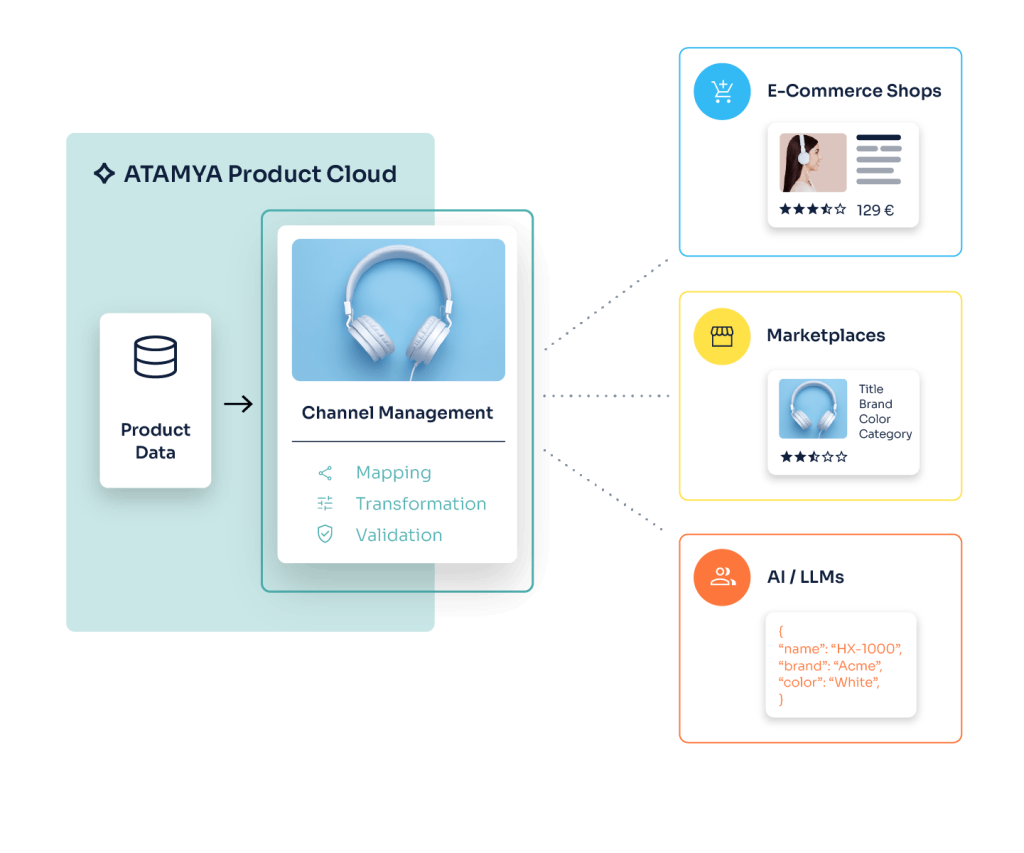
ATAMYA Product Cloud hero graphic showing product data flowing through channel management (mapping, transformation, validation) to e-commerce shops, marketplaces, and AI/LLMs

Ever expanding channel presence? When your processes run automatically, it doesn’t mean that the workload must grow at the same pace.

Set It Up Once. Then Let It Run On Its Own.

Map requirements of each channel to your product data. After that, ATAMYA applies them automatically. Your product data is delivered to all target platforms in just the right format, while your core PIM data remains unchanged.

Fewer Errors Across Channels

Channel-specific DQM. You define the quality roles and approval status for each channel. Ensure that only data that meets your quality standards are published.

Quickly Connect New Channels

With flexible mapping, you combine, split, convert, and filter attributes. The logic is firmly embedded in the channel mapping and is applied automatically each time data is published.

Enhance Channel Data with Live Sources

Enrich channel data by integrating a pricing microservice, inventory feed, or other live value. Mapping pulls external data into the channel object at runtime, quickly delivering up-to-date information to the channel.

Automatically Publish Changes

Data changes. Channels update. Publish new or changed data automatically based on events or schedules – without repeated manual exports.

From Shopware to BMEcat: One Approach

Connect standard formats such as BMEcat or ETIM/ECLASS through the same connector mechanism used for commerce platforms like Shopify and Shopware. A single source of truth, connecting various target systems.

No Publishing Lock-in

APIs, pre-configured integrations, or your own connectors – ATAMYA gives you the flexibility to adapt as your channel landscape changes.

Channel Management with ATAMYA:
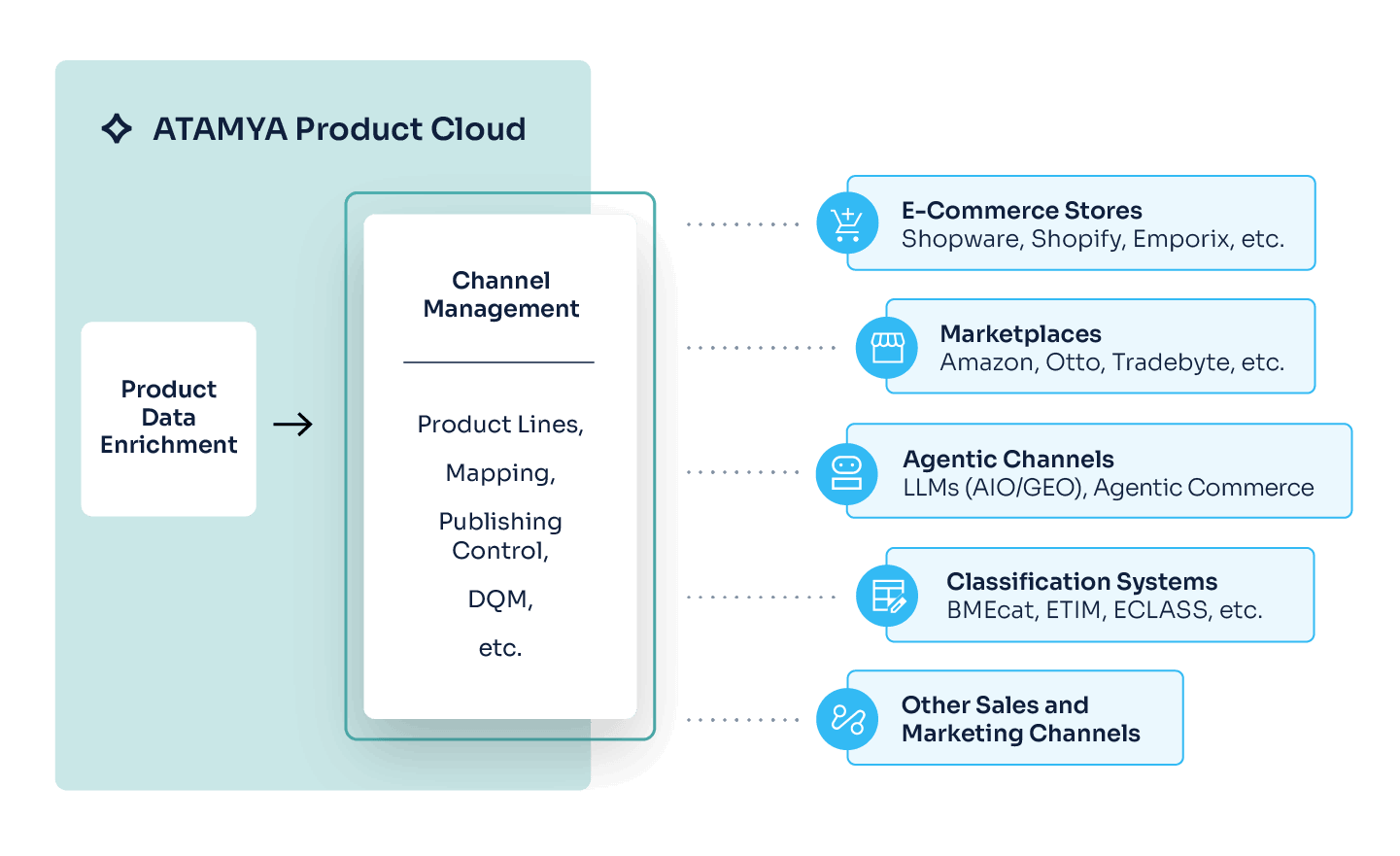
Each Channel Gets Exactly what it Needs

ATAMYA Product Cloud channel management distributing enriched product data to e-commerce stores, marketplaces, agentic AI channels, and classification systems such as BMEcat and ETIM

Your PIM Remains Your PIM

Each channel has its own requirements: different attributes, rules, and release processes. With ATAMYA, you can map and transform your media-independent product data into a dedicated channel object. This object is permanently stored in the respective target data model. Your original data in the PIM remains unchanged.

  • A dedicated target data model for each channel, including its own business logic
  • Persistent channel objects instead of mere export snapshots
  • The original remains the original: Your PIM data model stays media-neutral and stable
Channel management distributing PIM master data (SKU ID, product name, brand) into channel-specific product data for Channel A, B, and C

Mapping That Does More Than Just Field-to-Field

Channel mapping with ATAMYA does more than just transfer data: it can merge or split attributes, convert values, link text, select list entries, or filter image arrays. External data can also be integrated live at runtime – for example, current prices from a microservice.

  • Transformation logic per attribute: concatenate, split, merge, convert, filter
  • Integrate external data sources at runtime, such as for real-time prices
  • One mapping per channel – reusable and traceable
Data mapping and transformation process from PIM master data to channel-specific product data: combine, filter, price API, and direct mapping steps illustrated with a headphone product

From Shopify to In-house Development: Connectors for Every Channel

Every channel needs a connector that links ATAMYA to the target system and maps its data model and rules. You can develop it yourself, use a partner connector, or rely on a connector from ATAMYA – like Shopify, for example. This also works for ecommerce platforms like Shopware and commercetools or for standard formats such as BMEcat or ETIM/ECLASS.

  • Shopify connector ready to use, without in-house development
  • Connectors from partners or ATAMYA for additional platforms and formats
  • In-house connectors are an option if you want to control your business logic yourself

Discover Connectors & Integrations

ATAMYA Product Cloud architecture showing four core areas: channel connector, workflows/API, microservices, and integration

Print & Publishing with ATAMYA

What Works Digitally also Works for Print

Many publishing tools cater to both print and digital media, each with its own specific requirements. ATAMYA consolidates all of this into a single central database – for data sheets, catalogs, brochures, and more.

  • A single database for print, web, and mobile
  • Data sheets with a single click from brix or priint templates
  • Deep integration with priint:suite or InBetween for catalogs and brochures
  • Live data in the layout instead of manual updates
Channel management publishing PIM master data to print and publishing channels, including data sheets and product catalogs with layout templates

Do you have any questions?   Contact Us

FAQ – Product Data Syndication

How does ATAMYA’s Channel Management differ from traditional exports?

An export creates a point-in-time snapshot of your data. The Channel Management function persists the transformed data as separate objects in each channel’s target data model, with its own DQM rules, mapping, and approval status.

Do I need to develop a separate connector for every channel?

No. For systems such as Shopify, ATAMYA provides ready-to-use connectors. For other target systems, you can use connectors provided by partners or develop your own if you want to control the business logic yourself.

Can I include data from external sources in a channel mapping?

Yes. At runtime, the mapping can retrieve data from external sources, such as a pricing microservice, and write the values directly to the channel-specific object.

How do I control when data is sent to a target system?

Data can sent based on “Events” – whenever data changes – or based on a schedule, for example a nightly full synchronization. Both methods can be configured for each channel and are logged.

What other ways are there to access ATAMYA data?

Via the REST API for composable architectures, through API integration directly from within workflows, or via the standard integrations already available in the system.

Learn More About ATAMYA Product Cloud

ATAMYA Product Cloud – Experience It Live

Schedule a no-obligation demo of the ATAMYA Product Cloud today, and our PIM experts will show you how our PIM software can take your product data processes to the next level.

Schedule a Demo